
Soundscape Baselines Project
Biodiversity baselines for evidence-based conservation
Together with a network of local scientists, community members, and conservationists, we are creating global baselines of the world’s most intact forests, in terms of their soundscapes. We have now listened to 36 forest soundscapes for a full year. Along with images and remote sensing, this effort helps build time capsules of biodiversity now, as well as set benchmarks for conservation projects to measure up to. Learn about the most recent scientific publications here and listen to example soundscapes here.

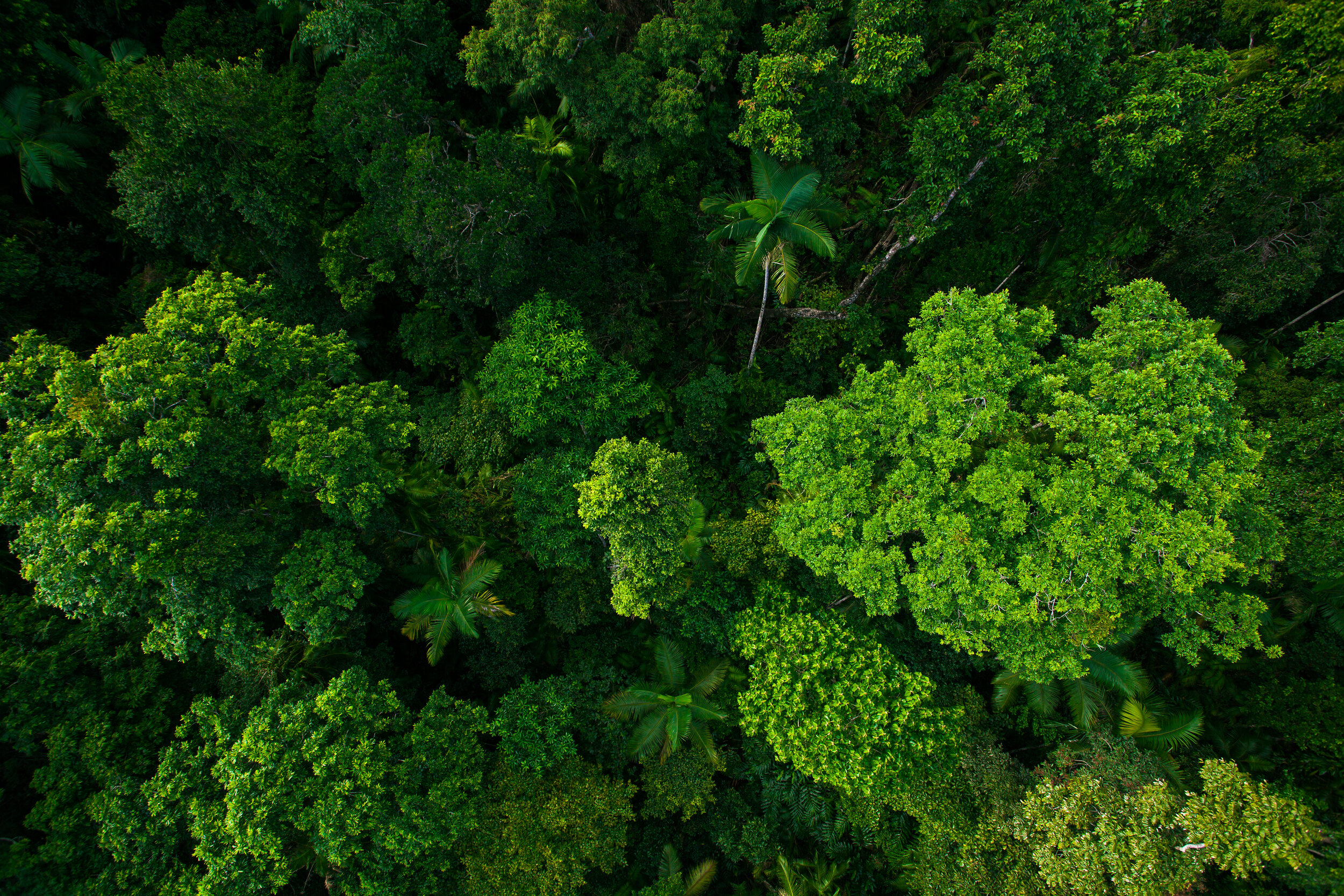
We are documenting what the world’s most intact forests sound like. Drone photos: Sound Forest Lab and Mongabay.

Vision
The Soundscape Baselines Project aims to develop a robust tool for measuring changes in biodiversity in the world’s forests against rigorous baselines, for the purpose of helping forest conservation efforts worldwide.
Why do we need baselines?
Tropical forests are at the front lines of extinctions of species. Spanning about 12% of Earth’s land, they harbor over half of terrestrial species. Counterintuitively, many conservation efforts in tropical forests do not measure how effective they are in terms of biodiversity protection.
In a quickly changing world, a fundamental problem is knowing what to compare biodiversity to. That is why we are establishing biodiversity baselines, by creating ‘time capsules’ of what the forest sounds like in each location.
We are listening to the forests 24h a day, for a full year.
We are also using camera traps to capture silent wildlife, and remote sensing to look at the canopy. This dataset is unprecedented in its temporal density, and spatial breadth - we are not missing a beat of what goes on in the forest. We can learn so much from the soundscapes, from what a ‘normal’ forest sounds like, to how different animals partition the available bandwidth to communicate. We capture the sounds of insects, frogs, birds, as well as mammals. Watch the video below to learn more about bioacoustics, and how it can help conservation.
How can you help?
The pilot phase of this project was sponsored by a grant from the Prince Albert II of Monaco Foundation, which helped us establish 36 baseline sites in 6 countries. If you’d like to help support the next phase, or see more baseline sites added, please get in touch! Ongoing Soundscape Baseline locations are highlighted below in large circles. Smaller blue dots show where we have preliminary recordings but not a full baseline.

What is the Soundscape Baselines Project?